
Why Your Dog Pulls on the Leash (And How to Finally Enjoy Walking Together)

Picture this.
You've had a long day at work, the weather is beautiful, and you decide to take your dog for a relaxing walk around the neighborhood. You clip on the leash, open the front door, and before you even make it to the sidewalk, your arm is stretched straight out in front of you.
Your dog is pulling toward the next smell, the next squirrel, the next person walking by, or simply racing to get wherever they think they're going.
What should be an enjoyable experience quickly becomes frustrating.
If this sounds familiar, you're certainly not alone. Pulling on the leash is one of the most common reasons dog owners contact us at Grassroots K9 St. Augustine.
The good news? Your dog isn't trying to be difficult.
In fact, they're doing exactly what they've accidentally been taught to do.
Understanding why dogs pull is the first step toward fixing it.
Why Dogs Naturally Pull
Dogs experience the world differently than we do.
While humans rely primarily on sight, dogs rely heavily on their incredible sense of smell. Every walk is filled with fascinating information.
Where another dog walked.
Which animal crossed the street overnight.
Who's been in the neighborhood.
New scents from the wind.
Interesting sounds.
Movement.
Everything is exciting.
Now imagine walking through Disney World for the very first time while someone asks you to ignore everything around you.
That's exactly what many dogs experience every time they leave the house.
Their excitement isn't disobedience.
It's curiosity.
Without guidance, curiosity quickly turns into pulling.
Pulling Works...So Dogs Keep Doing It
Here's something many owners never realize.
Every time your dog pulls and successfully reaches what they wanted, they've just rewarded themselves.
Think about a typical walk.
Your dog wants to sniff a bush.
They pull.
You continue walking.
Eventually, they reach the bush.
From your dog's perspective:
"I pulled...and it worked."
The same thing happens when they pull toward:
Another dog
A person
A tree
A fire hydrant
A park
The mailbox
Even if you're frustrated, your dog has already learned that pulling gets them where they want to go.
Dogs repeat behaviors that are successful.
It's Not About Being the Alpha
For years, people were told dogs pull because they wanted to "lead the pack" or become dominant.
Modern dog training has shown us that's simply not the case for the vast majority of dogs.
Most dogs pull because:
They're excited.
They're curious.
They've never been taught another way.
Pulling has been successful in the past.
Once you understand this, the solution becomes much clearer.
Instead of punishing excitement, we teach dogs that staying connected with their handler is actually more rewarding.
Equipment Isn't a Substitute for Training
One of the biggest misconceptions we see is that buying a new leash or harness will solve the problem.
There are countless products that promise to stop pulling overnight.
While some training tools can absolutely help when used correctly, no piece of equipment teaches your dog how to walk politely.
Training creates lasting results.
Tools simply help us communicate more effectively.
At Grassroots K9, we focus on teaching dogs what we want them to do—not simply preventing what we don't.
The Walk Starts Before You Leave the House
Many owners unintentionally create excitement before the walk even begins.
Think about what happens:
You grab the leash.
Your dog starts bouncing.
You say "Want to go for a walk?"
Now your dog is spinning in circles.
By the time you open the door, they're already in a highly excited state.
Instead, slow everything down.
Ask your dog to wait calmly.
Reward patience.
Only begin the walk once your dog is mentally ready.
A calm beginning often creates a calmer walk.
Stop Thinking of Walks as Exercise
This surprises many owners.
If your only goal is burning energy, walking often isn't enough.
Instead, think of every walk as a training opportunity.
Practice:
Checking in with you.
Walking beside you.
Sitting before crossing roads.
Ignoring distractions.
Waiting patiently.
Relaxing when you stop.
These little moments build communication.
Reward the Behavior You Want
Dogs learn through consequences.
If pulling gets rewarded, they'll continue pulling.
If walking beside you earns praise, food, play, or access to the environment, they'll begin choosing that behavior instead.
One of the most effective habits you can build is rewarding your dog whenever they choose to check in with you voluntarily.
Every glance toward you is an opportunity to reinforce engagement.
Why Consistency Matters
Imagine if every stop sign on your drive home was optional.
Sometimes you stopped.
Sometimes you didn't.
Eventually, you'd become confused about the rules.
Dogs experience the same thing.
If pulling is allowed one day but corrected the next, your dog receives mixed messages.
Clear expectations create confident dogs.
Consistency doesn't mean perfection.
It means everyone in the household follows the same rules.
Common Mistakes Dog Owners Make
At Grassroots K9, we see the same patterns every week.
Walking Too Fast
Your dog needs time to process information.
Slow down.
Constantly Talking
Many owners repeat commands over and over.
"Heel."
"Heel."
"Heel."
Eventually, the words lose meaning.
Instead, communicate clearly and reward the correct choice.
Expecting Too Much Too Soon
A dog that walks nicely in your driveway may struggle downtown.
Progress gradually.
Skipping Practice
Walking politely is a skill.
Like any skill, it improves with repetition.
Real-World Training Makes the Difference
One of the biggest reasons Grassroots K9 trains in real environments is because that's where dogs actually live.
Your dog doesn't spend their life inside a quiet training room.
They experience:
Busy sidewalks
Neighborhoods
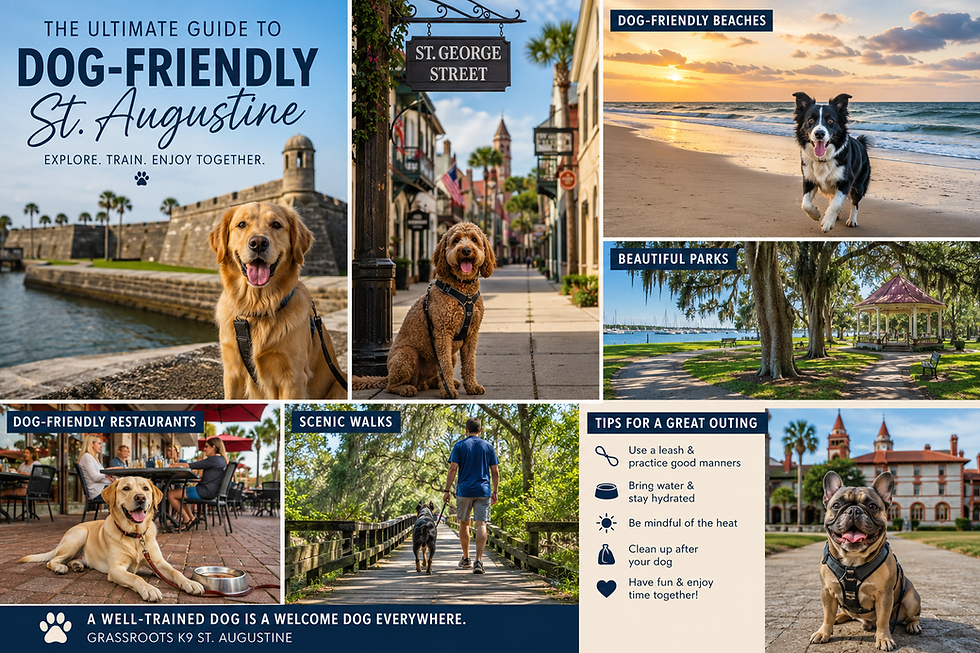
Downtown St. Augustine
Outdoor restaurants
Beaches
Parks
Children playing
Cyclists
Golf carts
Wildlife
Training in these environments helps dogs understand that the same expectations apply no matter where they are.
Imagine Walks That You Actually Enjoy
Imagine taking your dog through Historic Downtown St. Augustine without being dragged from one side of the sidewalk to the other.
Imagine enjoying coffee on a patio while your dog relaxes quietly beside you.
Imagine confidently exploring local parks, beaches, and trails without constantly worrying about what your dog might do next.
This isn't about creating a "perfect" dog.
It's about creating a dog that understands how to navigate the world alongside you.
That's the goal of training.
Frequently Asked Questions
Should I let my dog stop and sniff?
Absolutely. Sniffing is mentally enriching and an important part of being a dog. The key is teaching your dog when they have permission to exploqre and when they need to walk with you.
Does a harness stop pulling?
Not by itself. Some harnesses can provide better control, but no piece of equipment replaces clear communication and consistent training.
How long does it take to teach loose leash walking?
Every dog is different. With consistent practice and the right guidance, many owners notice significant improvements within a few weeks.
Is my dog too old to learn?
No. Dogs of all ages can learn new habits when training is clear, fair, and consistent.
Enjoy Every Walk With Confidence
Walking your dog should be one of the best parts of your day—not a battle.
At Grassroots K9 St. Augustine, we help owners transform frustrating walks into enjoyable experiences through practical, real-world training. Our programs focus on building clear communication, confidence, and reliable obedience in the environments where you spend your time.
Whether you're walking through your neighborhood, exploring Historic Downtown St. Augustine, or enjoying one of our beautiful local parks, we'll help you build a dog that walks with you—not against you.
If you're ready to stop being pulled down the sidewalk and start enjoying your walks again, schedule a free evaluation with Grassroots K9 St. Augustine today. Together, we'll create a training plan that fits your goals and helps you build the relationship you've always wanted with your dog.


Comments